
Seed, mulch and slope cover
Hydroseeding in Los Angeles, CA
New lawns, builder lots and bare hillsides, sprayed with the right mix for the coast, the basin or the Valley.
- No-charge visits to your property, with estimates in writing
- Itemized quotes: prep, seed, mulch and erosion control
- Seed mixes picked for coast, basin, valley or foothill
Growing Grass in a City That Gets 35 Rainy Days
Hydroseeding in Los Angeles is a race against two things: dry heat and the first big storm. Our trucks spray a mix of seed, wood or paper fiber, fertilizer and a tackifier glue onto soil that has already been prepped, and that fiber layer pins the seed down and keeps it moist until it sprouts. Homeowners call us for new lawns and lawn renovation, builders call for graded pads and slopes, and hillside owners call when bare ground needs cover before the rainy season. Our hydroseeding services cover all of it, from a small backyard to several acres of disturbed ground.
Semi-arid on paper, flood-prone in practice
Wikipedia's climate summary classes Los Angeles as semi-arid, close to the line of a Mediterranean climate, with only about 35 days of measurable precipitation in an average year. Summer is usually rainless. The catch is that average years are rare. A string of dry years with 5 to 10 inches is often followed by one or two wet years above 20 inches, and a series of rainy days can flood the lowlands and send mud down hills, especially after wildfire has stripped them. Seed and erosion control plans here have to work in both kinds of year.
Sandy valley ground
Much of the San Fernando Valley and the coastal plain sits on alluvial fans built from granitic rock. The USDA's official description of the Tujunga series, a soil first established in Los Angeles County, calls it very deep and somewhat excessively drained, with high saturated hydraulic conductivity. In plain terms, water goes straight through it. The same description notes the soil usually wets below about 30 centimeters sometime between October and December and stays moist at depth until April or May. That is the natural planting window, and it is why we pay for fiber mulch on sandy lots: the mulch layer holds water at the seed between sprinkler cycles.
Hydroseed, sod or dry seed?
Rolled-out sod looks finished by evening, but it is the priciest route to a lawn, and on a sunny Valley lot it needs heavy watering until the roots knit into the soil. Dry seed spread by hand or a broadcast spreader costs the least, but seed sitting on bare sandy soil dries out, blows around in a Santa Ana wind and gets eaten by birds. Hydroseed lands in between on price. The University of Nebraska Extension describes hydro-seeding as somewhat pricier than dry seeding and usually cheaper than sod. Its advantage is the mulch blanket, which matters more in a dry city than in a wet one. In good conditions, the first green from a hydroseeded yard tends to appear within 5 to 7 days, and most lawns are ready for the first mowing in 4 to 6 weeks.
When to seed for each kind of grass
Most lawns in the city are either cool-season tall fescue blends or warm-season grasses like bermudagrass. For fescue, we aim for fall. Autumn heat waves in September and October are common here, so we usually wait for that heat to break and spray in late October or November, ahead of the winter rains. Warm-season grasses need warm soil and go in from late spring into early summer, typically May and June, and they depend on irrigation because summer rain will not come. Near the coast, early-summer marine fog slows drying, which helps fescue and holds back bermuda. In the warmer valleys, freezing nights happen almost every winter, so a warm-season lawn goes brown and dormant for part of the year. We will tell you which grass suits your yard before we fill the tank.
Hillsides and the rainy season
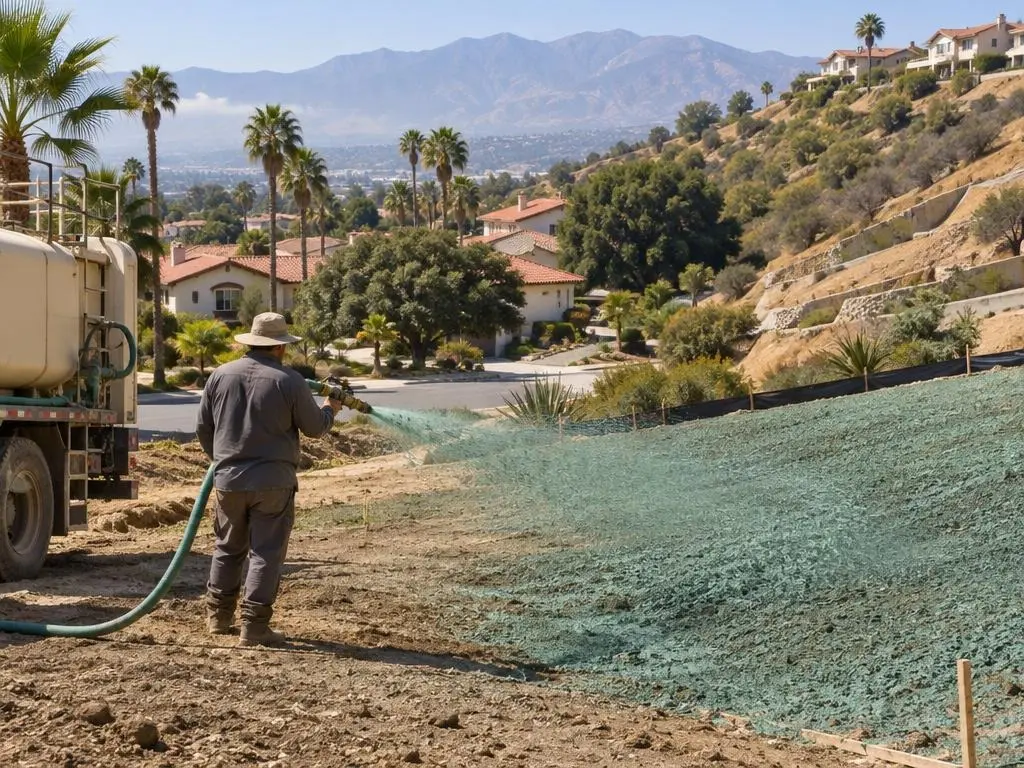
The Los Angeles Building Code declares October 1 through April 15 the rainy season. During those months, grading over 200 cubic yards on a permitted site cannot start until an erosion control system is approved, and hillside owners with unfinished grading over that size must file erosion control plans with their grading inspector before October 1. The code also requires cut and fill slopes in designated hillside areas to be planted and irrigated to grow ground cover. Slopes under 15 feet tall need grass or ground cover plus irrigation, and taller slopes also need shrubs or trees on a set spacing. Sprinklers on those slopes must apply no more than 3/10 inch of water per hour. To get a slope covered and growing within those rules, we rely on hydromulch, a bonded fiber matrix spray or rolled erosion control blankets, depending on the grade.
Mud, storm drains and the state permit
The State Water Resources Control Board regulates stormwater from construction sites. A project that opens up an acre or more of soil needs coverage under the state's Construction Stormwater General Permit, and so does a smaller parcel when it falls within a bigger development that crosses the acre mark as a whole. Even on a small remodel, city code says no excavation or fill may let soil or debris slide or flow onto neighboring property. Silt fence, fiber rolls and inlet protection keep sediment on the lot, and seed and mulch keep it there for good once grading ends.
How a typical job runs
- Site visit: soil check, slope, sun, irrigation and truck access
- Written estimate with prep, seed mix, mulch and erosion control itemized
- Grading, rock picking and topsoil where the ground needs it
- Silt fence and inlet protection before soil is left bare
- Spray: seed, mulch, fertilizer and tackifier in one pass, two on slopes
- Watering plan for your sprinklers, then a follow-up look at thin spots
Hiring a crew or renting a kit
Hydroseeding kits and rental machines exist, and for a few hundred square feet of flat ground a careful homeowner can get decent results. The trouble starts with bigger yards and any slope. A small machine applies thin, uneven mulch, the mix ratios are easy to get wrong, and a patchy spray shows up as a striped lawn six weeks later. Hydroseeding contractors bring a tank with mechanical agitation that keeps seed and fiber evenly suspended, so every square foot gets the same rate. We also carry the prep tools, the right seed for the season and the erosion control materials a slope needs. If your project is small and flat, we will tell you honestly whether a kit or dry seed would do the job.
Water use and lawn size
Statewide droughts have strained the city's water supply, and new grass is thirsty for its first month. We often suggest seeding only the turf area you will actually use, and putting slopes, parkways and side yards into a native or low-water mix. That keeps the lawn healthy on less water and still covers the soil.
Our Services
From valley backyards to burned canyon slopes: the six jobs Los Angeles customers hire us for.
New Lawn Hydroseeding
Hydroseed lawns for new homes, renovated yards and tired turf, with seed matched to coast or valley.
Learn more →Commercial Hydroseeding
Seeding for builders, developers and property managers: pads, basins, slopes and final stabilization.
Learn more →Hillside Erosion Control
Bonded fiber matrix, hydromulch, blankets and wattles for slopes, swales and burned hillsides.
Learn more →Silt Fence & Inlet Protection
Silt fence, fiber rolls, inlet protection and stabilized entrances to keep mud on the lot.
Learn more →Grading, Topsoil & Dirt Work
Yard grading, land grading, topsoil and the earthwork that sets a seedbed up to succeed.
Learn more →Native & Wildflower Seeding
California native grasses and wildflowers for hillsides, open areas and low-water yards.
Learn more →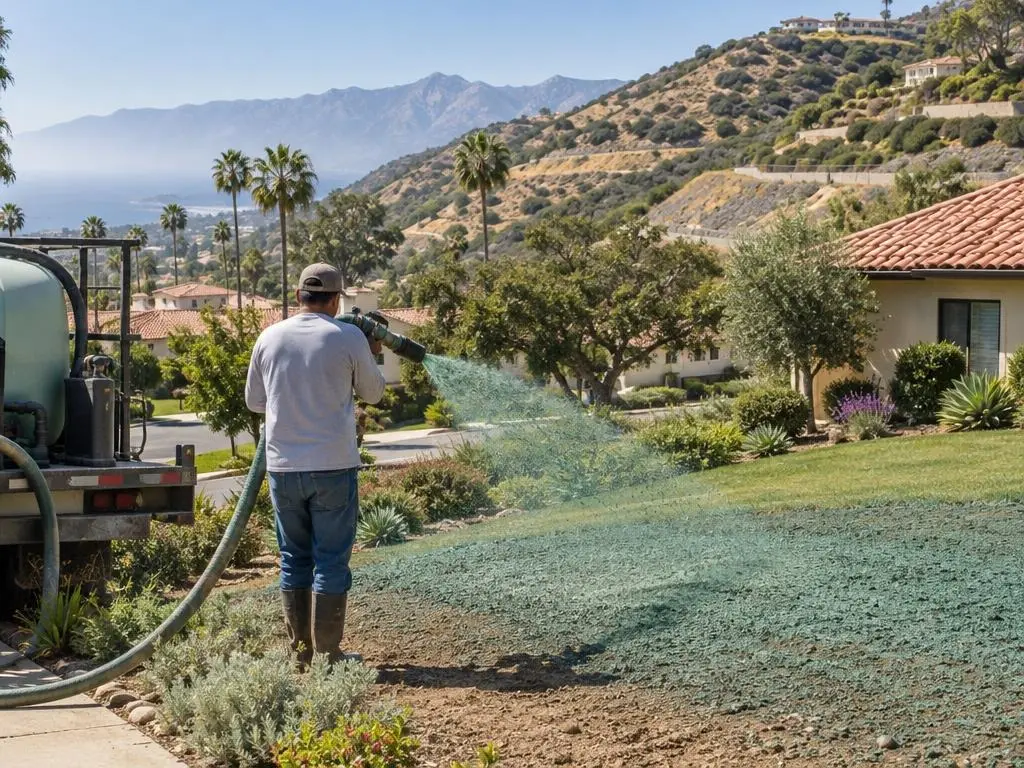
Why Homeowners Call Hydroseeding Los Angeles
Rain-calendar planning
We plan seed and erosion control around the October 1 to April 15 rainy season the city's grading code sets, not just around open dates on our schedule.
Mix matched to the microclimate
Coastal fog, hot valley floors and dry foothills each get a different seed blend and mulch rate.
Slope work done to code
Hillside slopes get ground cover, irrigation notes and the blanket or bonded fiber matrix the grade calls for.
Straight, itemized estimates
Prep, seed, mulch, silt fence and topsoil are each priced separately on the estimate, so nothing is buried in a lump sum.
Common Questions
Is hydroseeding worth the cost in Los Angeles?
For most lawns and slopes, yes. It costs more than dry seed but generally less than sod, and the mulch layer protects seed from sun, wind and runoff, which matters a lot in a dry city. On steep or burned slopes it is often the only practical way to get seed to stick.
What are the downsides of hydroseeding?
You wait several weeks for a usable lawn instead of one day with sod, and the area needs light, frequent watering until the grass is established. A heavy storm right after spraying can wash seed on bare slopes, which is why we add blankets or bonded fiber matrix on steep ground. Foot traffic and pets have to stay off for the first few weeks.
What time of year is best for hydroseeding in Los Angeles?
For cool-season fescue, late October and November, after the autumn heat and ahead of the winter rain. For warm-season grass like bermuda, late spring into early summer with irrigation. Erosion control seeding on slopes should go down before the first storms of the rainy season.
How often do I water a new hydroseeded lawn?
In warm weather, short sprinkler runs a couple of times a day, maybe three, so the mulch stays damp without puddles or runoff. On sandy valley soil you may need the shorter, more frequent cycle. We give you a schedule based on your sprinklers and your yard.
Can you hydroseed a hillside that burned?
Yes. On burned ground we focus on holding soil first, usually with bonded fiber matrix or blankets, wattles and silt fence at the toe, and we often use a native mix instead of turf. A slope that is unstable or actively sliding needs a geotechnical engineer before seeding.
Do I need a permit or erosion plan to seed my yard?
Seeding by itself usually does not need a permit. Grading does, and in the rainy season, permitted grading over 200 cubic yards cannot start until an erosion control system is approved. Projects disturbing an acre or more also need coverage under the state construction stormwater permit.
Will hydroseed grow on sandy soil?
It will, but sandy soil dries fast, so we often blend in topsoil or compost before spraying and use a heavier fiber mulch rate. The mulch layer keeps moisture at the seed between watering cycles.
How long until I can walk on or mow the lawn?
Grass usually shows in 5 to 14 days depending on weather and seed type. Most lawns get a first mowing at about 4 to 6 weeks, when the blades reach roughly 4 inches. Keep heavy use off until after a few mowings.
Neighborhoods, Valleys and Foothill Towns We Cover
Inside the city we work from the Westside and the coastal plain across the basin and through the San Fernando Valley. North of the Santa Clarita divide, Santa Clarita, Palmdale and Lancaster bring new subdivisions and high-desert ground where natives often beat turf. To the west, Calabasas, Agoura Hills, Westlake Village, Thousand Oaks, Moorpark and Simi Valley mix oak-shaded yards with fire-prone hills, and Malibu has some of the steepest burned slopes in the county. Along the San Gabriel foothills, Glendale, Burbank, Pasadena, Altadena, La Canada Flintridge, Sierra Madre, Glendora and Claremont deal with canyon runoff, heavier storms and lots cleared after fire. To the south and east, Rancho Palos Verdes, Whittier, Diamond Bar, Walnut and Chino Hills bring landslide areas, tract slopes and older grove soil. Each town page explains what makes seeding there different.
- Hydroseeding in Los Angeles, CA
- Hydroseeding in Santa Clarita, CA
- Hydroseeding in Palmdale, CA
- Hydroseeding in Lancaster, CA
- Hydroseeding in Thousand Oaks, CA
- Hydroseeding in Simi Valley, CA
- Hydroseeding in Calabasas, CA
- Hydroseeding in Malibu, CA
- Hydroseeding in Pasadena, CA
- Hydroseeding in Glendale, CA
- Hydroseeding in Burbank, CA
- Hydroseeding in Rancho Palos Verdes, CA
- Hydroseeding in Agoura Hills, CA
- Hydroseeding in Diamond Bar, CA
- Hydroseeding in Glendora, CA
- Hydroseeding in Claremont, CA
- Hydroseeding in La Canada Flintridge, CA
- Hydroseeding in Altadena, CA
- Hydroseeding in Whittier, CA
- Hydroseeding in Moorpark, CA
- Hydroseeding in Chino Hills, CA
- Hydroseeding in Walnut, CA
- Hydroseeding in Sierra Madre, CA
- Hydroseeding in Westlake Village, CA
Book a Free Site Visit Before the Rains
Tell us about your yard or slope and we will send a written estimate.